


Hair Extensions for Thin and Short Hair — Complete Guide
Patla baal, flat roots, styling jo tika nahi — agar ye sun ke tumhara din start hota hai, tum akeli nahi ho. Hair thinning is one of the most common concerns among Indian women, whether it's from PCOS, postpartum changes, thyroid, stress, or just genetics. The good news: you don't need a hair transplant, a miracle shampoo, or years of patience. The right hair extensions — chosen for your specific hair density, hair concern, and lifestyle — give you the volume and confidence you want, right now.
This guide covers every extension type that actually works for thin or short hair, how to wear each one, the mistakes that make extensions look fake on fine hair, and how to make them last.
What Causes Thin Hair — And Why Extensions Are the Safest Fix
Before choosing the right extension, it helps to know why your hair is thin. The cause affects which option works best:
- PCOS and thyroid imbalances — hormonal thinning usually affects the crown and parting first. Hair toppers and invisible patches are the most effective solution here.
- Postpartum hair loss — temporary but significant shedding, usually at the temples and front. Halo extensions and front hairline patches work well because they add volume without any pulling on already fragile regrowth.
- Genetics and fine hair — naturally thin strands that lack density. Seamless clip-in volumizers are the everyday solution.
- Stress, nutrition, or over-processing — diffuse thinning across the scalp. Volumizers at the crown and sides with a hair topper if needed.
- Short hair that you want to be longer — halo extensions and seamless clip-ins are your quickest route.
The Golden Rule for Thin Hair: Lightweight Over Everything
Heavy extensions on thin hair create two problems: the clips show because there isn't enough hair to cover them, and the weight pulls on fragile roots over time, which can actually worsen thinning. For thin or fine hair, the rule is always lightweight first — flat-lying wefts, silicone-lined clips, and even weight distribution across the head rather than concentrated at a few clip points.
Best Extension Types for Thin Hair — and Exactly How to Wear Each
1. Seamless Clip-In Volumizers — Best for Everyday Volume
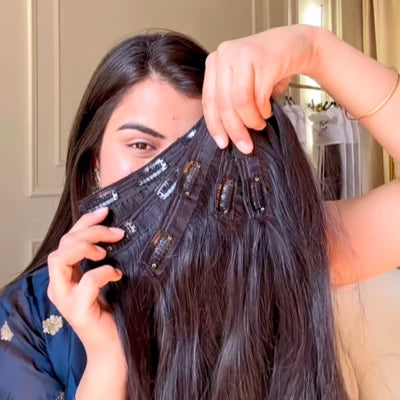
Seamless clip-in volumizers use an ultra-thin silicone base that lies flat against the scalp — no visible ridge, no bulk. The silicone base also grips your natural hair better than fabric-stitched wefts, which makes them more secure on fine, slippery hair.
Best for: Women with fine or thin hair who want everyday volume without visible clips or bulk
How to wear:
- Start with clean, dry hair. Avoid heavy oils or serums at the root before clipping in — they make clips slip.
- Lightly backcomb the roots at each placement spot. Even 5 seconds of teasing gives the clip something to grip.
- Start from the nape of the neck and work upward. Use larger wefts at the back, smaller wefts on the sides.
- Keep clips at least 2cm from your hairline and scalp — this is the "safe zone." On thin hair, clips placed too high show easily.
- After clipping in, release your natural hair over the wefts and style both together.
Thin hair tip: Go for one-set or two-set volumizers. More wefts don't always mean better volume on fine hair — the right weight is more important than more pieces. Heavy wefts on thin hair create a visible shelf at the clip line.

2. Halo Hair Extensions — Best for Thin + Short Hair
Halo extensions are the most damage-free option for thin hair. An invisible adjustable band sits around the crown of your head and the hair falls naturally from it — no clips, no glue, no stress on your roots. The weight distributes evenly across your whole head rather than concentrated at clip points, which makes it genuinely safe even for women with very fine or fragile hair.
Best for: Women who want no-clip, damage-free length and volume, especially fine or postpartum hair
How to wear:
- Place the halo band about 1 inch behind your natural hairline — not at the hairline itself.
- Use a tail comb to gently pull small sections of your natural hair over the band to hide it.
- Adjust the band for comfort — it should feel snug but not tight.
- Style your natural hair and the halo together with a curling iron or flat iron. This is what makes it look completely seamless.
Thin hair tip: Choose layered halo extensions rather than a blunt weft — layers blend better with thin natural hair and create more natural movement.
Short hair tip: For shoulder-length hair, go for 16–18 inches. For a bob cut, 14 inches or ask for a custom layered halo. Pair with a front hairline patch if you also have thinning at the front.
Lifespan: 3–4 years with regular use.

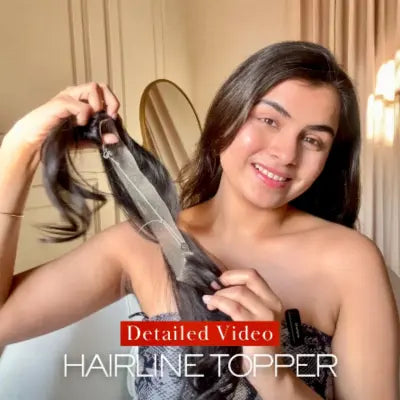
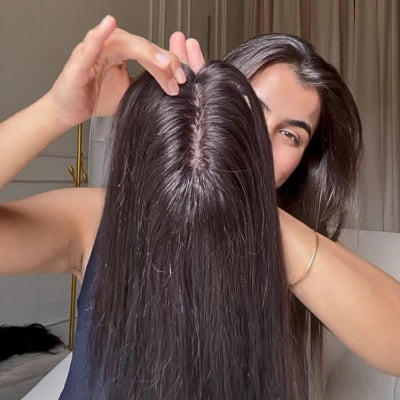
3. Hair Toppers — Best for Crown and Parting Thinning
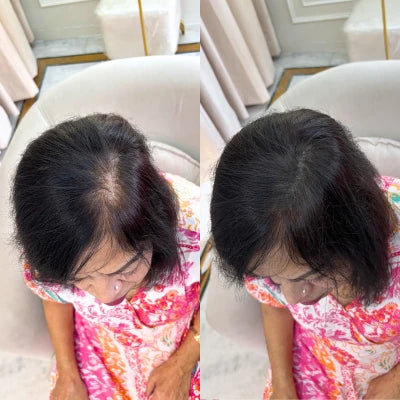
If your hair looks flat at the top, your parting has widened, or you can see scalp at the crown — hair toppers are designed exactly for this. They cover the specific area of thinning rather than adding bulk all over, which makes them the most targeted solution for women with visible crown or parting issues.
Best for: PCOS hair thinning, postpartum crown loss, widening parting, age-related thinning at the top
How to wear:
- Part your natural hair to align with the topper's parting line.
- Position the topper on your crown so it covers the thinning area completely.
- Secure using the built-in clips — start with the front clip first, then sides, then back.
- Blend by combing your natural hair gently over the topper's perimeter.
- Silk base toppers — mimic the natural scalp appearance at the parting. Best for visible crown thinning.
- Lace toppers — lighter and more breathable. Best for wider parting coverage.

4. Invisible Hair Patches — Best for Spot Coverage
Invisible hair patches are small clip-in pieces designed to cover specific thinning spots — temples, parting gaps, sides, or the front hairline. Where toppers cover a larger area at the crown, patches are for targeted, localised coverage.
Best for: Temple thinning, sparse parting, side hair loss, postpartum hairline gaps
How to wear:
- Identify the exact spot that needs coverage.
- Part your hair just above that spot.
- Clip the patch in along the section, pressing the clip closed firmly.
- Release your natural hair over it to cover completely.
Tip: Pair an invisible patch at the front with a halo extension for full coverage from hairline to length — this combination works really well for postpartum hair loss.
5. Clip-In Ponytail Extensions — Best for Short Hair Updos
Short hair that struggles to make a decent ponytail or bun — ponytail extensions are the fastest fix. Tie your natural hair into a small base ponytail, clip or wrap the extension over it, and you go from a 2-inch ponytail to a full, sleek one in under a minute.
Best for: Short hair that can't hold a ponytail, special occasions, office looks
Tip: Use a messy bun scrunchie on days when even a ponytail is too much effort — clip it at the base of any ponytail and you have an instant voluminous bun.
6. Clip-In Bangs — Best for Front Thinning and Short Hair
Clip-in bangs do two things at once for thin or short hair: they cover a receding or sparse front hairline, and they change the whole face frame without cutting anything. For women with thinning temples or a visible front hairline, curtain bangs are particularly effective because they cover the sides naturally.
Comparison Table — Which Extension for Which Concern
| Your Concern | Best Extension | Why |
|---|---|---|
| Overall thinness, flat hair | Seamless volumizers | Flat base, lightweight, adds density throughout |
| Short hair, want length | Halo extensions | No clips on short hair, instant length, 3–4 year lifespan |
| Crown or parting thinning | Hair toppers | Targeted coverage exactly where needed |
| Temple thinning or hairline gaps | Invisible patches | Small, precise clip-in for spot coverage |
| Short hair, want a ponytail or bun | Ponytail extensions | Wraps over natural hair base, instant updo |
| Front hairline thinning | Clip-in bangs | Covers sparse front hairline, frames face |
| PCOS thinning at crown | Silk topper | Natural scalp appearance, covers thinning partition |
| Postpartum hair loss | Halo + invisible patch combo | No pull on fragile regrowth, covers front and length |
What About Tape-In Extensions?
Tape-in extensions are popular globally and some women with thin hair do use them. They lie flat against the scalp and distribute weight across the attachment points rather than concentrating it at clips. However, they require professional application and removal, last 6–8 weeks before repositioning, and use adhesive that can cause stress on already fragile strands if not removed correctly. If you're considering tape-ins, consult a professional hairstylist who has experience with fine hair before committing.
For most Indian women with thin hair who want something they can wear and remove themselves without salon visits, clip-in volumizers and halo extensions are more practical and safer for daily use.
Styling by Hair Length — What Works Best
Short Hair (Chin to Shoulder)
- Go for a shorter extension length — 14 to 16 inches blends far better than 20 inches on a bob
- Use fewer wefts — 1 or 2 well-placed volumizers blend better than 5 on short hair
- Always curl or wave both your natural hair and extensions together after putting them on
- For front volume, pair curtain bangs with a halo for a complete style
- Consider a flat clip ponytail — designed specifically for thin and short hair, the flat base sits closer to the head
Medium Hair (Shoulder to Collarbone)
- Half-up, half-down styles with a two-set volumizer at the crown work beautifully
- Soft loose curls help blend extensions with natural hair at any density
- Layer different extension lengths — mix shorter and longer wefts for natural-looking dimension
Long Thin Hair
- Loose beach waves are the easiest blend — the curl movement hides where extensions begin
- A sleek high ponytail with a ponytail extension instantly transforms long but flat hair
- Use a hair topper at the crown for density at the root while volumizers add length at the sides

Mistakes That Make Extensions Look Fake on Thin Hair
- Going too heavy — the most common mistake. Seven-set extensions on thin hair creates a visible ridge and weight that pulls roots. Always start with a lighter set and add if needed.
- Placing clips too high — on thin hair, clips need to be at least 2cm from the scalp with sufficient hair above to cover them completely. Too high and the weft shows.
- Wrong colour match — on thin hair, even a slight mismatch is visible because there's less natural hair covering the extension at the point of attachment. Match in natural daylight to your ends, not your roots.
- Not styling together — putting extensions in on already-styled hair means they move differently. Always clip in first, then style natural hair and extensions together.
- Clipping too close to the hairline or nape — edges are the most visible areas on thin hair. Keep extensions in the middle and back sections where there's more hair to hide the clips.
- Ignoring texture match — straight extensions on wavy thin hair don't blend well. If your hair is naturally wavy (most Indian hair is), go for wavy texture extensions or style both together.

Care Tips That Keep Extensions Lasting Longer on Thin Hair
- Remove clip-ins before sleeping — on thin hair, sleeping in extensions causes tangles that pull on already fragile strands
- Don't clip in on oiled hair — oil on the scalp transfers to the clip area and causes slipping all day
- Wash after 10–15 wears, not more — over-washing strips extensions faster than anything else
- Store in a silk carrier, always dry and detangled
- Use a loop brush — regular brushes pull at the weft base and cause shedding

Frequently Asked Questions
Are hair extensions safe for thin hair?
Yes, as long as you choose the right type and weight. Clip-in volumizers, halo extensions, hair toppers and invisible patches are all designed to be lightweight and damage-free. What damages thin hair is using extensions that are too heavy, placed incorrectly, or worn 24 hours a day without giving your natural hair breaks.
Will clip-in extensions show on very fine hair?
They can if placed incorrectly. The key is to use seamless extensions with a flat silicone base, keep clips 2cm from the scalp, and ensure you have enough natural hair above each clip to cover it completely. Using a lighter set also helps — on fine hair, fewer wefts placed correctly are always better than many wefts placed wrong.
What are the best extensions for PCOS-related hair thinning?
Crown and parting thinning from PCOS responds best to a silk base hair topper — it covers the thinning area at the top while blending naturally into your existing length. Pair with seamless volumizers on the sides for overall density. For wider parting specifically, lace toppers are more effective than silk base.
What extensions work for postpartum hair loss?
Postpartum hair loss is usually at the temples and front hairline — fragile regrowth that can't handle clip tension. Halo extensions (no clips, weight distributed evenly) paired with a front hairline patch covers both length and the hairline without any stress on new growth. This combination is one of our most commonly recommended for new mums.
Can I wear extensions on short hair?
Yes — but length choice matters. Don't go more than 6–8 inches longer than your current hair length or the extension will look disconnected. For a bob, 14–16 inch extensions blend best. Halo extensions work particularly well on short hair because there are no clips to hide in limited hair length.
How long do Shell Hair extensions last on thin hair?
Clip-in volumizers last 1.5–2 years with proper care for regular use. Halo extensions last 3–4 years. Hair toppers last 2–3 years depending on how often they're worn and heat styled. The biggest lifespan killers for thin-haired users are over washing and sleeping with extensions in.
How do I know which extension is right for my specific hair?
The easiest way is to book a video consultation with us — ₹100, fully redeemable on your order. We'll look at your hair, understand your concern, and tell you exactly which extension, what weight, what length, and what shade. You can also read our guide on hair extensions for different hair types for more guidance.



Leave a comment
This site is protected by hCaptcha and the hCaptcha Privacy Policy and Terms of Service apply.